

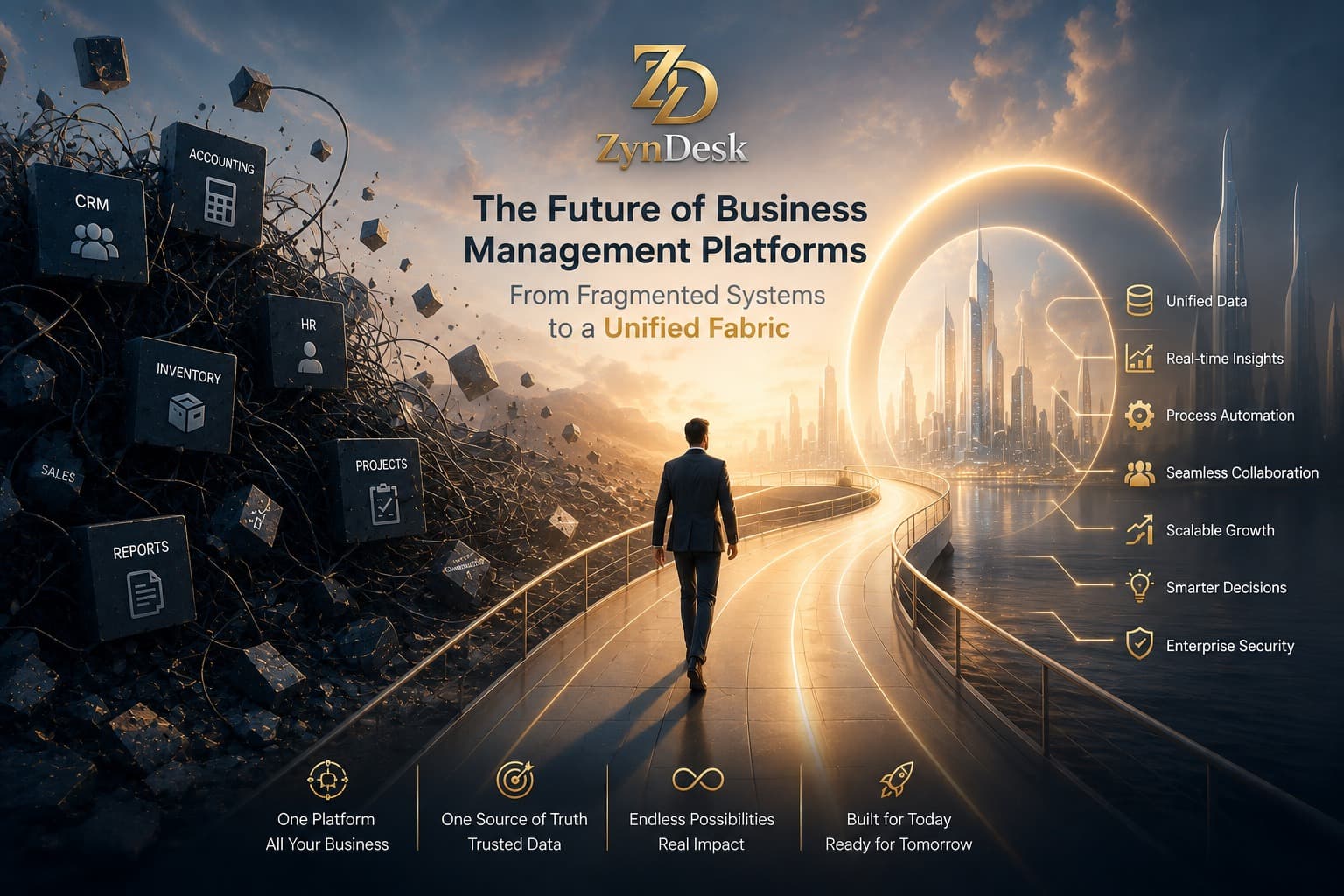
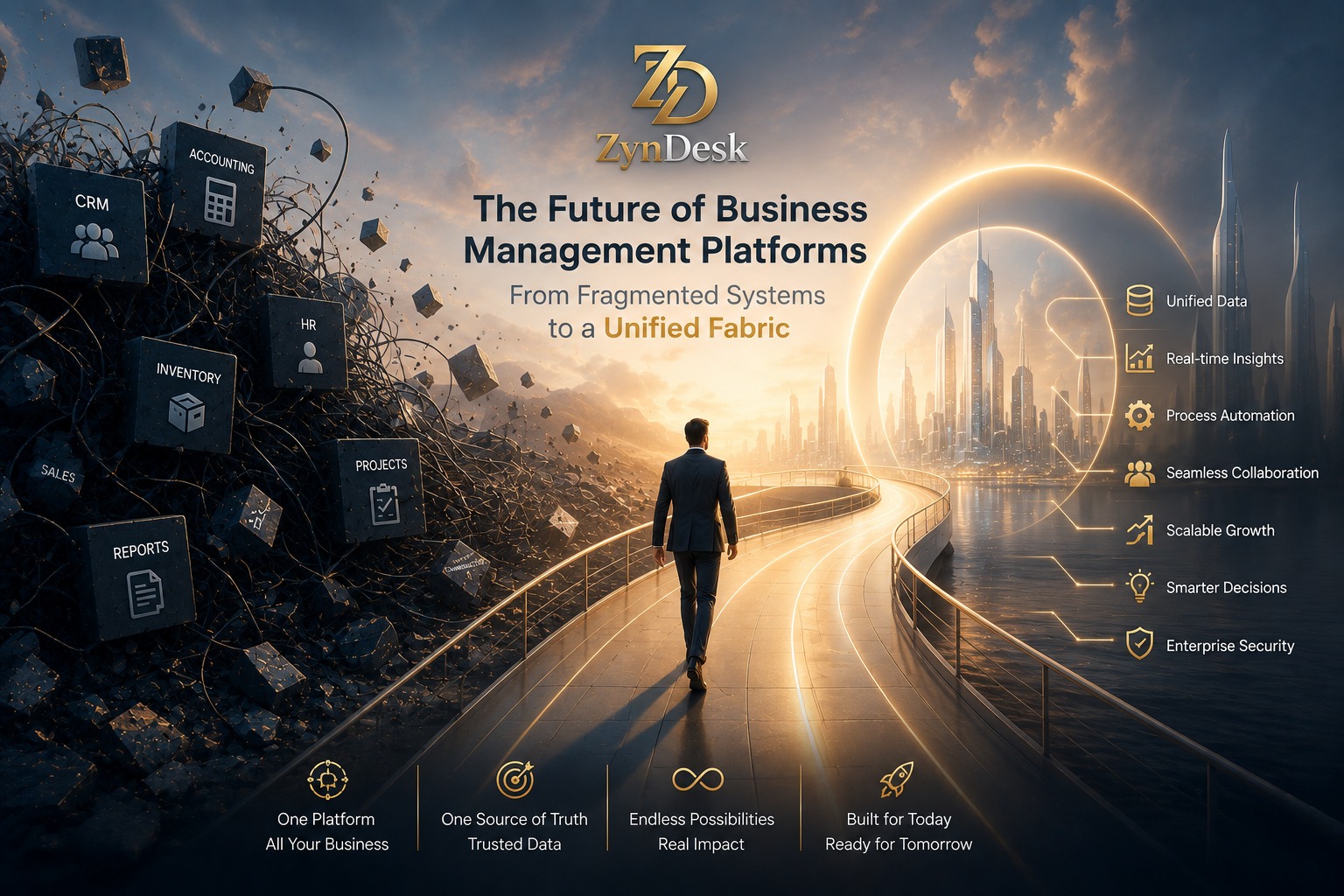
The Future of Business Management Platforms: From Fragmented Systems to a Unified Fabric
The Future of Business Management Platforms: From Fragmented Systems to a Unified Fabric
Every minute, organizations make dozens of operational decisions that directly affect performance, growth, and the customer experience. But what happens when every decision rests on different data? The problem then isn't a lack of information — it's the absence of a unified view that ties it all together.
Behind every successful organization lies a story customers never see: a story of daily decisions about inventory, customer service, financial planning, human resources, and supply chains. These decisions may look separate, but together they form the complete picture of the organization's performance. And when they're built on data scattered across systems that don't talk to each other, that picture becomes incomplete, and delays, errors, and poor coordination multiply.
This isn't just an operational challenge. According to a McKinsey report, organizations that base their decisions on unified, more integrated data are better able to improve performance and respond to change faster. This reflects an important truth: unifying data is no longer just a technical improvement — it has become a core pillar of competitiveness.
This is where the real cost begins. The problem isn't that each department has its own data — it's that this data lives inside separate systems that can't see the full picture. Sales may be working from figures that differ from what the customer service team sees, while finance holds numbers that never reach operations, and HR manages its data on an entirely separate platform. Without connection, the organization turns into a collection of isolated islands, and making a fast, accurate decision becomes far harder.
For many years, companies believed the best path to progress was buying specialized software for every function: one system for accounting, another for customer relationship management, a third for inventory, a fourth for HR, a fifth for project management. Over time, these systems stopped being integrated solutions and became separate work environments, each with its own database and its own way of operating.
At first, this approach seemed practical and effective. But as businesses grew, the gaps gradually began to show. Employees started spending more time moving data between systems, while managers had to piece together reports from multiple sources just to get a clear picture of the organization's performance. Customers were the first to feel the impact of this disconnection, forced to repeat the same information every time they dealt with a different department.
The paradox is that today's organizations don't suffer from too few systems — they suffer from too many. Each system performs its function efficiently within its own boundaries, but fails to see the full picture. It's as if every department is looking at one piece of a large painting, while no one sees the whole image.
For this reason, the question leading organizations ask is no longer “What software do we need?” It has become: “How do we make every part of our business work as one system?”
This shift in thinking is what's shaping the future of business management platforms.
When Data Becomes a Shared Language
Picture a manager starting the day with a quick meeting with their team. They ask about sales and get a number that differs from the one finance has. They move on to inventory status and discover the report in front of them is a week old. Then they discuss customer service performance, only to find the data is still being updated.
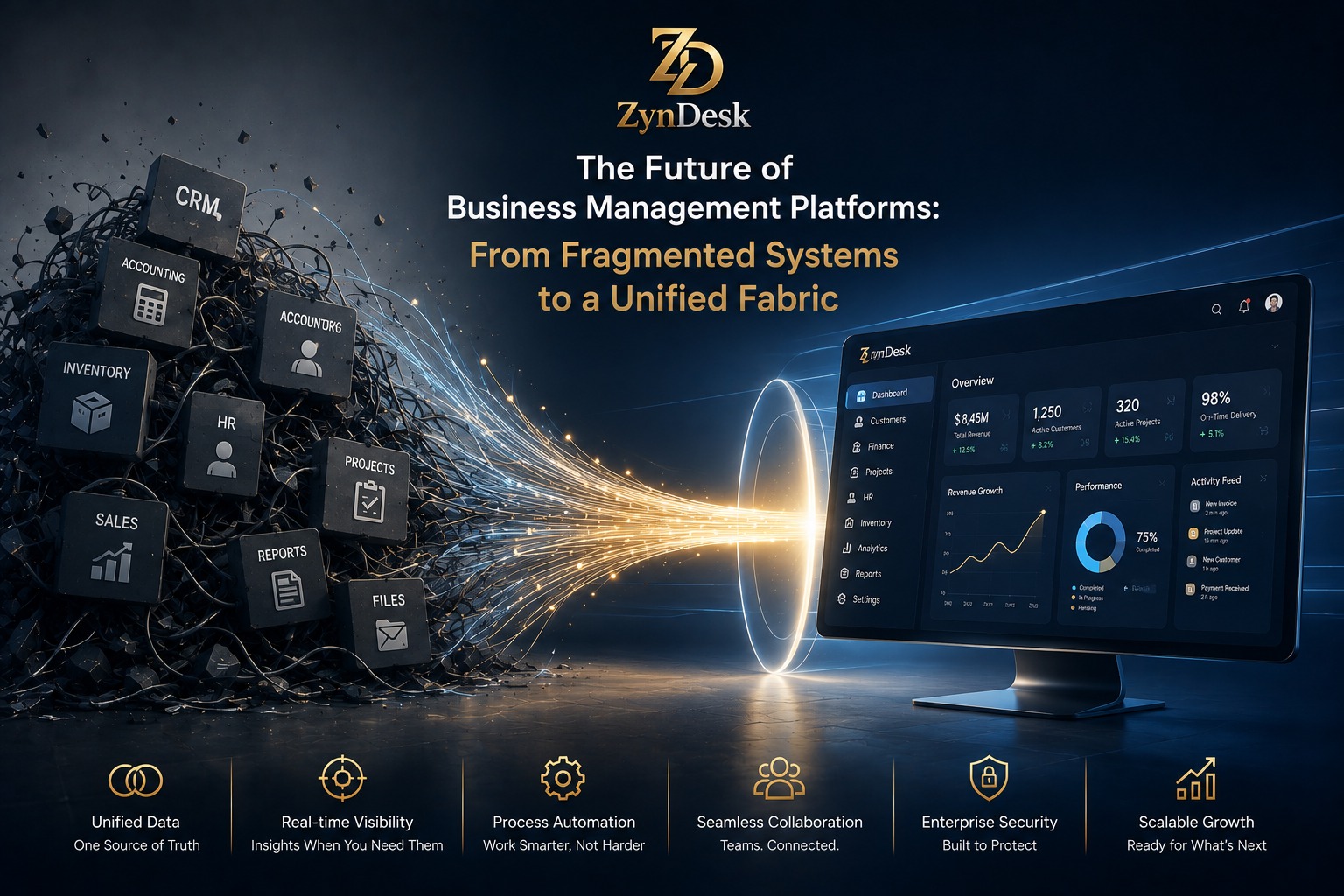
When every department operates within its own isolated system, data becomes fragmented and it's hard to make a decision based on a complete picture. A unified platform, by contrast, treats data as a shared language that flows between all departments in real time, speeding up decisions and reducing errors.
The problem here isn't employee competence or system quality — it's that every system lives in its own world.
If the sales team registers a new customer, that update reaches finance, customer service, and operations instantly, with no need for emails, Excel files, or repeated manual entry.
This simplicity isn't a technical luxury — it's the foundation on which fast, accurate decision-making is built.
A manager who sees the organization's full picture on a single dashboard can spot opportunities before competitors do, address problems before they escalate, and plan for the future with greater confidence.
From Software to a Unified Fabric
Perhaps the best way to describe the future of business management is a shift from the idea of a “collection of software” to the idea of a “unified business fabric.”
A fabric doesn't get its strength from a single thread, but from all the threads woven together.
And that's exactly what organizations need today.
The goal is no longer to own the best accounting system, the best CRM, or the best project management tool in isolation — it's to build a work environment where all these functions collaborate naturally, so employees feel they're working inside one system, no matter how many processes they run.
This connectivity is reflected directly in the customer experience too.
When a customer reaches out to an organization, they don't care how many systems it uses — they care about getting a fast answer, accurate service, and a consistent experience at every touchpoint.
When an organization achieves this internal harmony, it's automatically reflected in customer trust — trust that's hard to buy, but is built through repeated experiences where the customer feels the organization truly knows them, understands their needs, and moves quickly to serve them.
How Digital Transformation Changed the Rules of the Game
Years ago, simply owning a business management system was a competitive advantage in itself. Today, that's no longer the case.
Most organizations now own a variety of software to manage their operations, but the real difference is no longer about owning the technology — it's about that technology's ability to work in harmony.
This is where digital transformation, in its true sense, appears.
Digital transformation isn't about replacing paper with screens or moving data to the cloud — it's about building an organization that operates as a single unit, where information flows seamlessly and every decision rests on shared data.
The CFO no longer waits until month-end to know financial performance; the sales director no longer relies on delayed reports to understand market movement; and the customer service team no longer works in isolation from marketing or operations.
Everyone sees the same picture... at the same moment.
And that is the real power of unified business management platforms.
Why Fragmented Systems Can No Longer Keep Up with the Future
Fragmented systems may seem effective when an organization is just starting out, with a limited headcount, simple processes, and a small volume of data.
But the more an organization grows, the more its operations become complex, and the greater the need to exchange data between departments — and this is where fragmented systems begin to show their limits.
At this stage, it isn't just the organization that grows — complexity grows right along with it.
These steps might look simple when viewed individually, but over time they turn into thousands of wasted hours every year.
Even worse, every manual step opens the door to a new possibility for error:
A mistake entering a number.
Forgetting to update a piece of information.
Relying on an outdated version of the data.
And in a world where markets move at unprecedented speed, that small error can be enough to lose an important customer or a major investment opportunity.
The Hidden Cost That Never Shows Up in Reports
When organizations discuss the cost of their systems, they usually focus on subscription fees or software licenses.
But the real cost doesn't show up on the subscription invoice — it shows up in:
Time lost searching for information.
Meetings dedicated purely to reconciling numbers.
Rebuilding reports from scratch.
Opportunities lost because data arrived too late.
These aren't small details — they're a daily drain that repeats silently until it becomes part of the routine.
And because organizations get used to it, they stop noticing it, even though it may be the real reason behind slowing growth.
The Unified Fabric... When an Organization Works as One Mind
Imagine every department inside your organization as a cell in the human body.
A unified platform is like the organization's nervous system: it connects every department, so that a single update automatically triggers the rest of the processes, with no manual intervention needed.
When a sale is recorded, the system automatically updates inventory, issues the invoice, notifies the shipping team, updates the financial reports, and adds the customer's data to the CRM — with no manual work or waiting.
Not just because the system is faster, but because it thinks with the logic of the whole organization, not the logic of a single department.
This is where technology shifts from being just a tool for executing tasks into a true partner in running the business.
Data... the Organization's Most Valuable Asset
The value of data isn't in collecting it — it's in turning it into knowledge available at the right moment. That's why unified platforms give an organization a single source of truth that supports transparency and faster decision-making.
Organizations no longer collect data just to hold onto it — they use it for forecasting, analysis, and decision-making.
An executive doesn't just want to know what happened yesterday — they want to know what might happen tomorrow.
This is where unified platforms matter: they gather data from every department into a single dashboard and turn it into understandable indicators that help management make more accurate, more confident decisions.
Instead of dealing with dozens of separate reports, the organization gets a single source of truth, which reduces conflicting numbers, raises transparency, and gives every team a unified view of business goals.
When Employee Experience Becomes a Competitive Advantage
Often, all the focus goes to the customer experience while the employee experience is neglected, even though the two are closely linked.
An employee who spends half their day switching between systems, searching for information, or re-entering the same data won't be able to give their best.
Over time, frustration turns into lower productivity, and then into resistance to any new change.
But when employees work within a unified platform, daily tasks become smoother, and they feel technology is supporting them rather than complicating their work.
This is reflected directly in speed of delivery, quality of service, and even the organization's culture itself.
Smart systems don't just make organizations more efficient — they make the work environment more comfortable, more collaborative, and more capable of innovation.
Artificial Intelligence... When the Platform Doesn't Just Understand What's Happening, but Anticipates What Will
The role of business management systems in the past was clear and limited: record data, store it, then generate reports when needed. That was enough at a time when the pace of business was slower, data volumes were smaller, and there were fewer variables.
Today, the landscape has completely changed.
Organizations don't just need to know what happened — they need to understand why it happened, what might happen next, and what decision needs to be made now, before a problem turns into a crisis.
This is where the real role of artificial intelligence emerges.
AI is no longer just an impressive technology or a marketing feature bolted onto a product — it has become an intelligent layer working in the background, watching patterns, analyzing data, connecting events, and giving management insights that help it make more accurate decisions.
Imagine a platform noticing a gradual drop in order frequency from an important customer, comparing that drop against their history and the behavior of similar customers, and then alerting the sales team before that customer loses interest altogether.
Or discovering growing pressure on a production line and suggesting a resource reallocation before a delivery delay happens.
That's the difference between a platform that just records events and one that helps shape the future.
From Reaction to Anticipation
Many organizations suffer from a management style built entirely on reaction.
The problem shows up first, then everyone starts searching for a solution.
Customer satisfaction drops, so meetings get scheduled.
Sales decline, so plans get reviewed.
Employee turnover rises, so management starts asking why.
But more mature organizations don't wait for the problem to happen — they look for its earliest signs.
This is why modern business management platforms now rely on predictive analytics that help spot trends before they turn into real challenges.
It's an entirely different philosophy.
Instead of managing the past, the organization starts managing the future.
The Cloud... the Infrastructure That Made Work Borderless
Before cloud computing spread widely, business management systems were often tied to a specific location.
If you were out of the office, reaching your data could be difficult.
And if local servers went down, operations could stop for hours, or even days.
But as cloud technologies matured, the concept of a “workplace” became far more flexible than ever before.
Cloud computing made it possible to access data and collaborate across teams from anywhere, strengthening business flexibility and continuity.
This shift didn't just give organizations more freedom — it made them better able to adapt to change, whether that's market expansion, new ways of working, or even global crises that demand uninterrupted business continuity.
Flexibility Is No Longer a Choice... It's a Condition for Survival
If recent years have taught us anything, it's that markets don't stay still.
Customer needs change.
Technology evolves.
Competitors keep innovating.
And in this ever-changing world, it isn't always the biggest organizations that succeed — it's the most adaptable ones.
That's why flexibility has become one of the most important standards modern business management platforms are built on.
A successful platform isn't one that only meets an organization's needs today — it's one that can grow alongside it tomorrow.
When an organization opens a new branch, enters a different market, or launches a new service, it shouldn't have to start the search for a new system from scratch.
Instead, the platform itself should be able to absorb that growth, add new capabilities, and integrate with modern technologies, without complicating or disrupting the business.
Why Are Organizations Moving Toward One Platform Instead of Dozens of Tools?
Because they've realized the problem was never a shortage of software.
It was too much software.
Every new tool adds value in one area, but also adds operational cost, administrative overhead, and extra complexity. A unified platform reduces that complexity through a single interface, a single database, and one unified source of information.
This doesn't just make work easier — it reduces errors, raises team efficiency, and gives management a comprehensive view that lets it plan with confidence.
The Technology the Customer Feels Without Ever Seeing
Customers don't usually ask what business management system your company uses.
But they feel its results every time they interact with you.
They feel it when they get a fast response.
And when they don't have to repeat their information.
And when their orders arrive when expected.
And when they find that every employee has the same information.
All these small details add up to one great experience.
From here, investing in a unified business management platform isn't just an investment in technology — it's an investment in the trust an organization builds with its customers, day after day.
Systems may be invisible to the customer, but their impact is clearly reflected in every experience the customer has with the organization.
With this shift, the question is no longer “Do we need a unified platform?” It has become: “How long can we delay this shift without losing opportunities for growth and distinction?”
Smart Organizations Aren't Built with Software... They're Built with Vision
In the business world, it's easy to buy new software, and just as easy to swap one system for another. But what's genuinely hard to build is a work ecosystem capable of growing without losing its coherence.
Organizations preparing for the future don't ask, “What's the newest technology available?” They ask, “How do we make technology serve our vision, instead of forcing us into its way of working?”
And that's the difference between an organization that merely uses technology and one that builds its future through it.
Unified platforms don't just save time — they redefine the relationship between people, data, and decisions. They give employees more room to focus on creativity, give managers greater clarity of vision, and give customers an experience where they feel the organization truly knows them, rather than dealing with them through scattered files.
It isn't just a technical shift — it's a shift in mindset.
The Future of Business Management Platforms... Toward More Connected Organizations
In the years ahead, platforms will become smarter and more integrated, capable of suggesting improvements and connecting every process into a single unified experience, turning data into an engine for growth rather than just a record of information.
How Does ZYNDESK Embody This Vision?
At ZYNDESK, we don't see business management as a collection of separate modules — we see it as an interconnected journey that begins with an idea, grows with every decision, and thrives when information flows freely across every department.
That's why the platform was designed to bring an organization's diverse needs together in one environment, so that processes integrate instead of competing, and data collaborates instead of scattering.
When sales, HR, operations, finance, and customer service all work through one platform, coordination becomes smoother, decisions become more accurate, and everyone feels they're working toward a shared goal.
This integration doesn't just mean less complexity — it means building an organization that's more ready to grow, more able to adapt to change, and more resilient in the face of future challenges.
Because true success isn't achieved by owning the largest number of tools — it's achieved by owning tools that work together in harmony.
This is why ZYNDESK wasn't designed to be just another business management platform, but to be the infrastructure that unifies data, processes, and decisions within a single system that supports sustainable growth.
Technology That Gives People Room to Create
There's a common belief that technology replaces people — but reality proves the opposite.
The best technologies are the ones that free people from repetitive tasks and give them time to think, innovate, and build better relationships with customers.
When a platform takes over routine processes, data synchronization, and reporting, teams get more time to focus on what machines can't do: creativity, understanding customer needs, and generating new ideas.
From here, the future of business management platforms isn't a future run by machines alone — it's a future where human capability integrates with technological potential to achieve results that weren't possible before.
“Can our organization keep competing if its data and processes stay scattered across systems that don't talk to each other?”
Perhaps real transformation doesn't begin with choosing new software, but with rethinking the way data and teams communicate inside the organization.
The organizations that will lead the future aren't necessarily the biggest — they're the ones most able to connect knowledge, technology, and people.
And that is where the path toward a smarter organization begins... one more ready for what's next.