

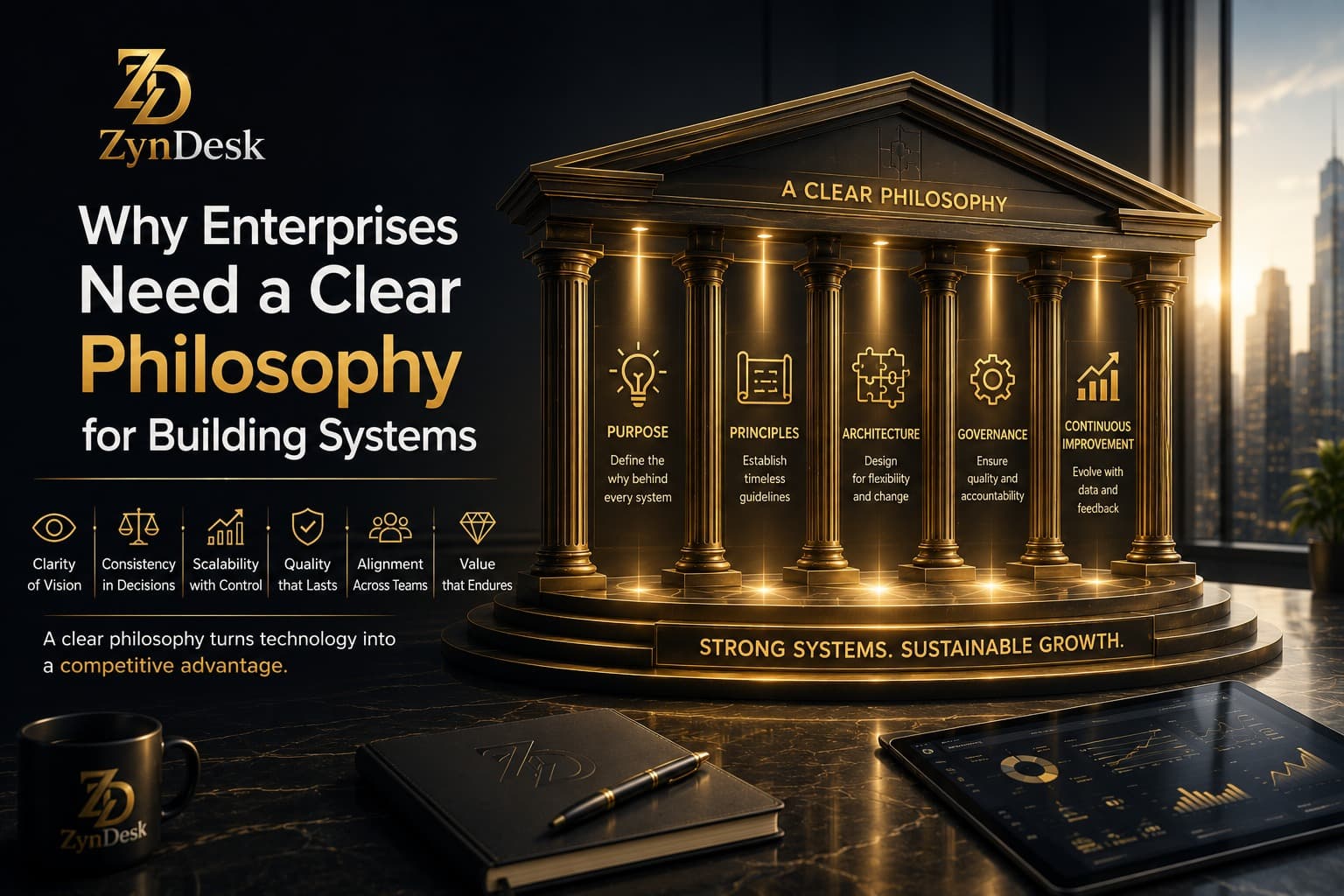
Why Enterprises Need a Clear Philosophy for Building Systems
Why Enterprises Need a Clear Philosophy for Building Systems
When an enterprise looks for a system to manage its business, it often focuses on a checklist of features: Does it support sales management? Does it include a financial system? Can it be linked to inventory? Does it provide reports and dashboards?
While these questions matter, they don’t reveal the full picture. Successful systems aren’t built by stacking together a collection of features and functions — they start from a clear philosophy that defines how the system should work, and how it can keep pace with an enterprise’s growth and evolving needs over time.
For this reason, ZYNDESK doesn’t view enterprise business solutions as software that performs specific tasks, but as an integrated system that helps organizations operate more intelligently, efficiently, and sustainably.
Building a strong enterprise system doesn’t start with writing code — it starts with understanding the nature of the business, the daily challenges facing different departments, and how technology can simplify operations without adding new complexity.
Technology Alone Is Not Enough
In recent years, the software world has seen a major boom, and it has become easy to find dozens of systems performing nearly identical functions. Yet not all of these systems achieve the same success within organizations.
The reason is simple: technology on its own has no value if it isn’t designed to match the needs of its users and the nature of their work.
How many enterprises have invested in an advanced system, only to struggle to use it? How many companies have been forced back to spreadsheets because the system was too complex and didn’t fit their way of working?
These experiences confirm that the success of any platform doesn’t depend solely on its technical capabilities, but on the principles it was built on from the start.
This is where ZYNDESK’s vision comes in — one focused on building practical, flexible, and easy-to-use solutions capable of evolving alongside the enterprise.
ZYNDESK’s Philosophy in Developing Business Solutions
ZYNDESK believes that enterprises don’t need complex systems — they need smart systems that simplify work, help employees perform their tasks efficiently, and enable management to make decisions based on accurate data.
For this reason, the company relies on a set of core principles that guide every stage of solution design and development — from studying the client’s needs, through building out the various functions, to continuously updating the platform to keep pace with changes in the business market.
These principles aren’t marketing slogans — they are practical standards reflected in every part of the platform, directly shaping the user experience and the quality of performance.
Principle One: The Customer Is the Starting Point
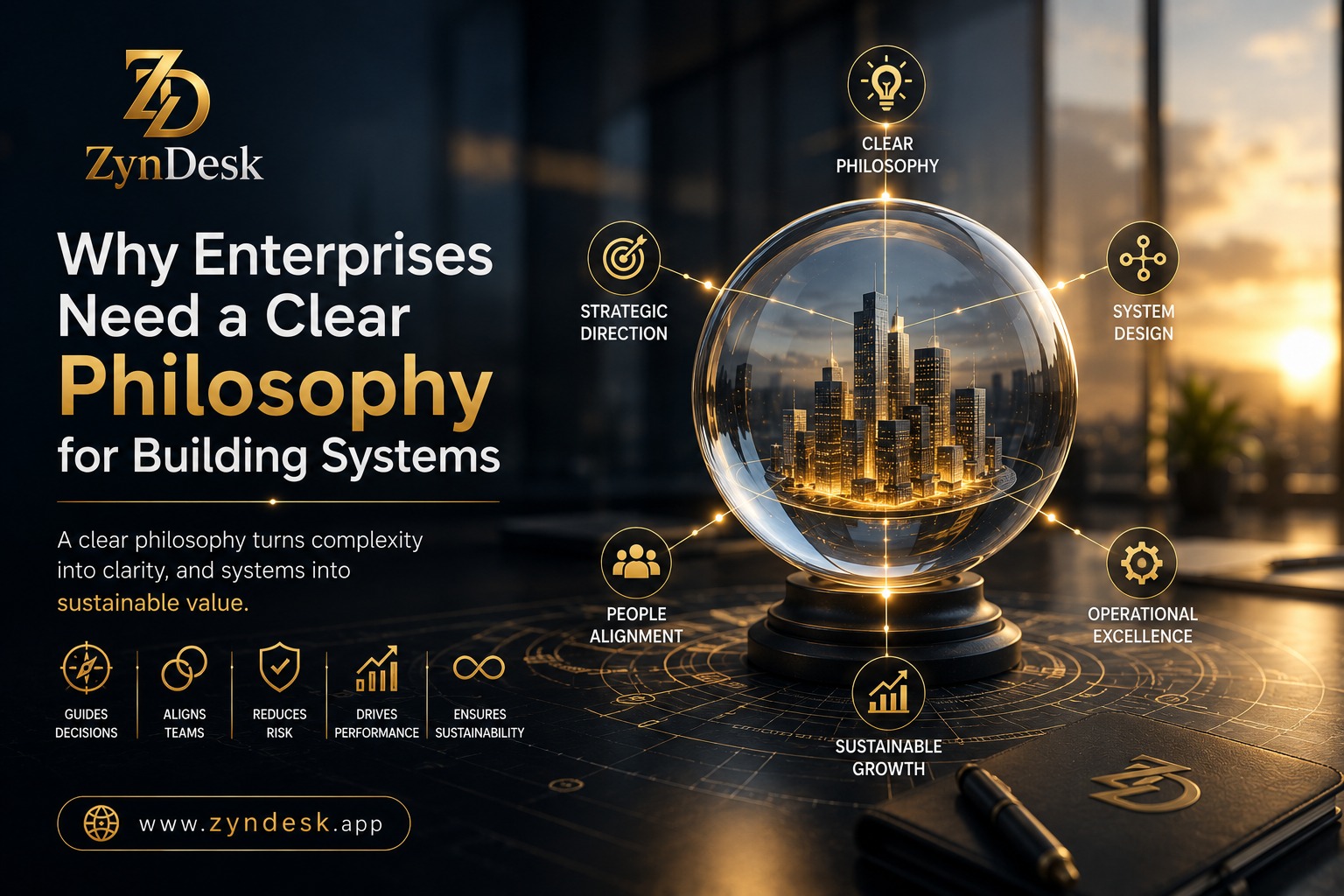
It’s easy for a software company to build a system packed with hundreds of features, but the real challenge is making sure that system truly fits the enterprise that will use it.
This is why ZYNDESK begins every development process by understanding the nature of the client’s business, rather than simply presenting a list of ready-made features.
Needs vary from one sector to another. Factories have requirements different from service companies, and educational institutions need different tools than e-commerce businesses.
Solutions are therefore designed with the nature of the activity, the size of the enterprise, the number of users, and future growth plans in mind — making the system more capable of delivering real value from day one.
Principle Two: Integration Before Addition
Many enterprises rely on a large number of separate programs, with each department running its own system, without any real connection between them.
This environment leads to:
● Repeated data entry
● Conflicting information
● Slow report generation
● Weak collaboration between departments
● Higher likelihood of errors
For this reason, ZYNDESK believes the priority isn’t adding more features, but building a unified platform that connects all operations within the enterprise.
When data moves automatically between sales, inventory, finance, and human resources, work becomes more seamless, and managers can access a comprehensive picture of enterprise performance at any moment.
This integration saves time, improves data quality, and gives management a stronger foundation for decision-making.
Why These Principles Are Essential for the FutureIn a rapidly changing world, enterprises relying on rigid solutions that are difficult to develop or modify won’t succeed. Instead, the enterprises that will thrive are those with flexible systems capable of adapting to change and absorbing new technologies without needing to rebuild their digital infrastructure from scratch.
This is why ZYNDESK doesn’t view enterprise solutions as a project that ends once the system launches, but as an ongoing development journey aimed at keeping pace with client needs and market changes.
The Five Principles Behind Our Enterprise Business Solutions
Principle Three: Flexibility and Scalability Aren’t a Feature—They’re a Necessity
One of the most common mistakes enterprises make when choosing a business management system is thinking only about their current needs, without considering what they might require three or five years down the line.
A system may be a good fit at the start, but it can become a hindrance as the enterprise expands, opens new branches, grows its workforce, or adds new products and services.
For this reason, ZYNDESK views scalability not as an optional extra, but as one of the foundations any successful enterprise system must be built on.
A company with twenty employees today might, within a few years, grow into an organization with hundreds of employees managing multiple branches at home or abroad. In that case, it shouldn’t be forced to replace its entire system — the system should be able to grow with it, step by step.
For this reason, ZYNDESK’s solutions are built on a flexible architecture that allows for adding new modules, expanding permissions, and connecting additional departments — without disrupting workflow or requiring the system to be rebuilt from the ground up.
Real Growth Requires a System That Evolves With the Enterprise
Often, companies don’t face difficulties managing their business in the early stages — the challenges begin as operations scale up.
As the number of customers rises, daily orders increase, and revenue sources diversify, operations become more complex and pressure mounts on teams.
If the system can’t accommodate this growth, problems emerge, such as:
● Slow execution of operations
● Delayed report generation
● Duplicate data
● Reduced employee efficiency
● Difficulty tracking different branches
For this reason, ZYNDESK designs its systems so that each stage of an enterprise’s growth becomes a natural extension of the previous one, without requiring a radical shift in the work environment.
At the start, a company was running a single branch, a single warehouse, and a small sales team — so the system met all of its needs at the time.
Three years later, it opened five new branches, added an online store, and expanded its customer service team.
Had the system not been flexible, the company would have been forced to replace it entirely — with all the cost, work disruption, and data loss that entails.
But with a flexible platform like ZYNDESK, new branches can be added, warehouses connected, permissions expanded, and different sales channels merged within the same system — all while maintaining a single, unified database for all operations.
Principle Four: Data Is the Foundation of Every Successful Decision
Enterprises generate thousands of data points every day related to sales, customers, inventory, human resources, purchasing, and finance.
But having data alone doesn’t mean an enterprise is able to make better decisions.
The real value emerges when this data is transformed into clear information, and then into insights that help management plan and make decisions.
This is why ZYNDESK believes an enterprise system shouldn’t simply record data — it should help understand, analyze, and make use of it.
From Numbers to Decisions
Imagine a sales manager who knows that this month’s sales reached one million pounds. That’s important information, but it isn’t enough to make a decision.
What the manager actually needs to know is:
● Which products are generating the most profit
● Which regions have seen the highest growth rates
● Which sales categories are the most efficient
● Who the most active customers are
● Why sales of certain products have declined
When this information becomes available instantly, decision-making becomes faster and more precise.
This is why ZYNDESK provides interactive dashboards and smart reports that help managers track performance indicators in real time, without needing to prepare manual reports that take hours or days.
Business Intelligence Is Part of Every Process
In the past, data analysis tools were reserved for senior management only.
Today, it has become essential for the right information to reach the right person at the right time.
An inventory manager needs to know which products are running low.
An HR manager needs to track performance indicators and attendance rates.
A financial manager needs a clear view of cash flow and future obligations.
For this reason, ZYNDESK integrates business intelligence tools directly into the platform, so every user gets the information that helps them carry out their daily tasks and make decisions with confidence.
Why This Principle Will Matter Through 2030
Forecasts indicate that the volume of data generated by enterprises will continue to grow at an accelerating pace in the years ahead.
With this growth, the challenge won’t be collecting data — it will be the ability to understand and use it correctly.
Enterprises that invest in building a data-driven culture will be better positioned to:
● Anticipate market changes
● Improve the customer experience
● Raise operational efficiency
● Reduce risk
● Discover new growth opportunities
How These Principles Affect Employees
Some might assume that system development only benefits management, but the reality is different.
When a system is flexible, integrated, and data-driven, every employee benefits from it.
Employees spend less time on data entry, find the information they need more easily, avoid repeating work, and can complete their tasks faster.
Managers also gain a clearer view of their teams, while customers experience faster, more accurate service.
In this way, the impact of the principles ZYNDESK follows isn’t limited to the technical side — it extends across the entire work experience.
Technology Should Simplify Work, Not Complicate It
There’s a common belief that powerful systems have to be complex.
But experience has proven the opposite.
The best systems are the ones a new user can learn quickly, navigate easily between functions, and use to complete tasks without unnecessary steps.
This is why ZYNDESK is committed to designing clear user interfaces and organizing processes logically, so users feel the system is helping them rather than imposing a complicated way of working.
A good user experience isn’t just an aesthetic detail — it’s a factor that directly affects how quickly a system is adopted, how productive employees become, and how much value a company gets out of its investment in technology.
The Five Principles Behind Our Enterprise Business Solutions
Principle Five: Continuous Innovation Is the True Guarantee of Sustainability
In the business world, no system can ever be considered "complete" forever. What meets an enterprise’s needs today may not be enough two or three years from now, because markets change, technologies evolve, and customer expectations keep rising.
This is why ZYNDESK doesn’t simply build a system and stop there — it embraces the concept of continuous innovation as one of the core pillars for building enterprise business solutions capable of keeping pace with the future.
Innovation here doesn’t mean randomly adding new features — it means listening to customers, monitoring market trends, analyzing enterprise needs, and then developing the platform in ways that create real value for the user.
Every update should make the system faster, more flexible, easier to use, and more capable of supporting decision-making.
Continuous Development Starts With Customer Needs
The best ideas don’t always come from development teams — they often start with the users themselves.
A sales manager might notice a step that could be shortened, an HR officer might suggest a better way to manage leave requests, or a financial manager might need a new report to help track cash flow.
In ZYNDESK’s philosophy, these observations aren’t treated as mere support requests — they represent important input for developing the platform.
For this reason, the development team continuously reviews customer feedback, turning it into practical improvements that reflect real market needs rather than theoretical assumptions.
When the Five Principles Come Together
Each of the principles above may seem important on its own, but the real value emerges when they work together within a single system.
When a system is:
● Designed around the customer’s needs
● Built on integration across all departments
● Flexible and scalable
● Able to turn data into practical decisions
● Subject to continuous development and innovation
the result is a platform capable of supporting enterprises through every stage of their growth, without technology ever becoming a burden or an obstacle.
This is the vision ZYNDESK works to embody in every solution it offers — because the goal isn’t limited to managing daily operations, but extends to empowering enterprises to build a more stable and efficient future.
How These Principles Affect Enterprise Performance
The five principles may sound like strategic concepts, but they directly influence the day-to-day results an enterprise achieves.
When applied correctly, a range of clear improvements can be observed, such as:
● Reduced time spent executing operations
● Fewer errors resulting from manual entry
● Improved data quality across the enterprise
● Faster decision-making cycles
● Greater efficiency in collaboration between departments
● Improved customer experience
● Increased employee productivity
● Support for growth without needing to repeatedly change systems
These results don’t happen overnight — they are the outcome of building an enterprise system on clear foundations, rather than on temporary fixes.
Successful Enterprises Don’t Buy Software—They Build a Work Ecosystem
One of the concepts that has shifted most in recent years is that enterprises are no longer looking for a program that performs a specific function, but for a technology partner that helps them fully transform the way they work.
For this reason, the success of any digital transformation project doesn’t depend on the number of features in the system, but on how well it can adapt to the enterprise’s needs and support it in facing future challenges.
ZYNDESK believes that successful enterprise solutions are the ones that grow with the enterprise, help it improve performance, and give it a clearer view of its operations — while maintaining simplicity and ease of use.
Why This Philosophy Represents Real Value for Enterprises
The nature of companies may differ from one sector to another, but most face similar challenges, such as:
● Multiple data sources
● Slow procedures
● Difficulty preparing reports
● Weak communication between departments
● The need for faster decision-making
By relying on the five principles ZYNDESK builds on, it becomes possible to address these challenges in an integrated way, rather than settling for partial fixes to each problem individually.
Each principle reinforces the others, creating a work environment that is more flexible, more responsive to change, and better prepared for growth.
The Future of Enterprise Business Solutions
All indicators point to the coming years bringing greater reliance on artificial intelligence, data analysis, automation, and cloud computing — fundamentally changing the way enterprises operate.
But despite this evolution, the core principles behind building systems will remain the deciding factor between solutions that deliver real value and those that merely follow technical trends.
This is why ZYNDESK believes that investing in technology must start with understanding the enterprise’s needs, then designing flexible, scalable solutions that put the user at the heart of the experience and make data the foundation of every decision.
Work tools are constantly changing, but the principles underlying successful systems remain constant. Enterprises seeking sustainable growth need solutions that don’t just manage operations, but help improve performance, strengthen collaboration between departments, and enable more precise decisions.
With this in mind, ZYNDESK builds its enterprise solutions on five core principles: understanding customer needs, integration between systems, flexibility and scalability, reliance on data, and continuous innovation.
These principles aren’t just a development philosophy — they form a framework designed to empower enterprises to face today’s challenges and confidently prepare for tomorrow’s opportunities.
As digital transformation continues across every sector, enterprises that invest in systems built on solid foundations will remain the most competitive, the fastest to adapt, and the best prepared to achieve long-term success.
Frequently Asked Questions
What are enterprise business solutions?
They are integrated digital systems that help organizations manage various operations — such as finance, sales, human resources, inventory, and customer service — through a single platform.
Why does integration between systems matter?
Because it reduces data duplication, speeds up operations, and gives management a unified view that supports precise decision-making.
How does flexibility support enterprise growth?
By making it possible to add new users, branches, and modules without needing to replace the entire system — reducing costs and maintaining business continuity.
What role does data play in enterprise business solutions?
Data helps measure performance, analyze trends, identify opportunities for improvement, and make decisions based on accurate information rather than estimates.
Why does ZYNDESK rely on continuous innovation?
Because enterprise needs are constantly changing, and continuous development ensures solutions stay aligned with modern technologies and market demands while delivering practical value.