

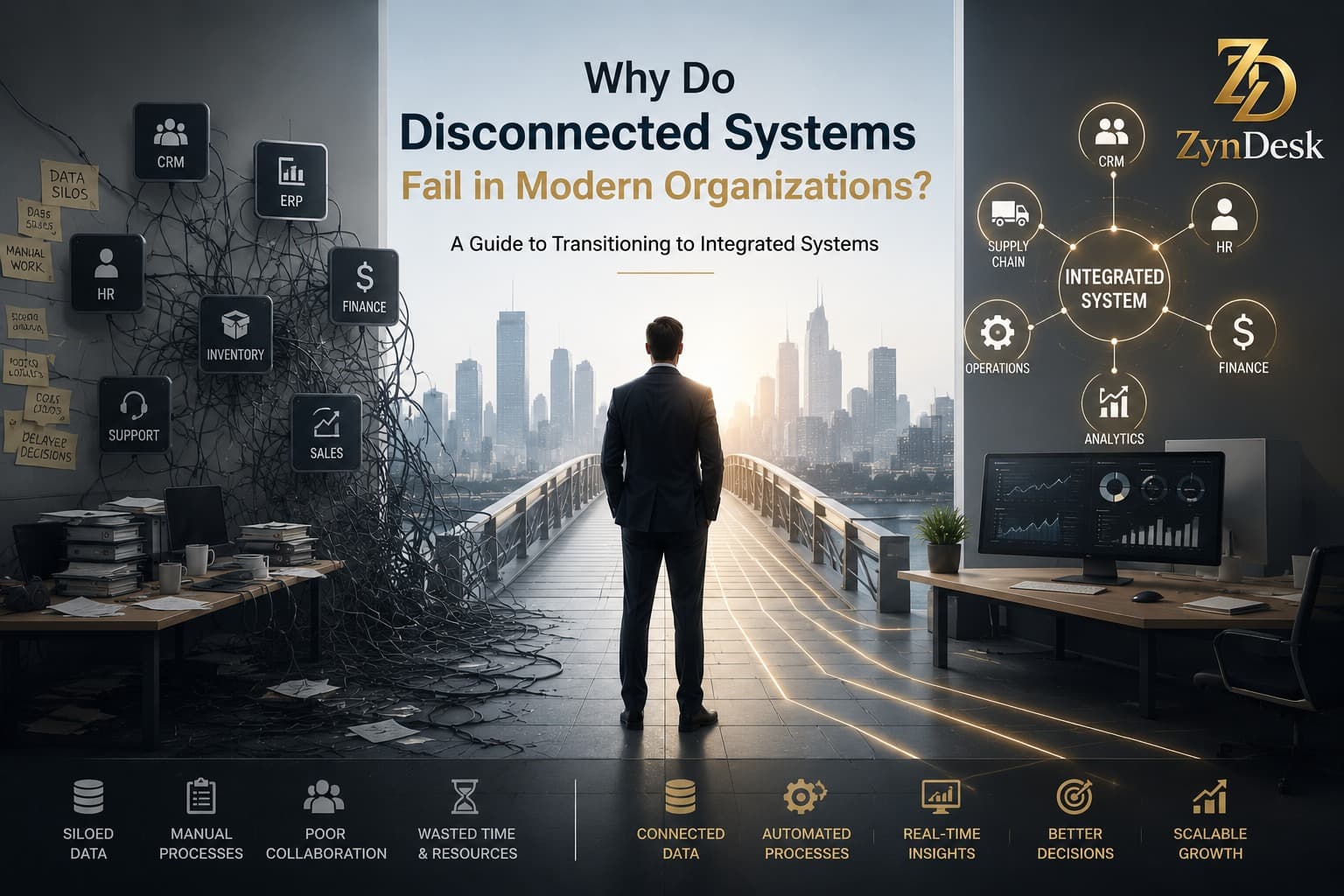
Why Do Disconnected Systems Fail in Modern Organizations? | A Guide to Transitioning to Integrated Systems
Why Did Disconnected Systems Fail to Keep Up with the Complexity of Modern Organizations?
● Disconnected systems lead to data duplication and a higher rate of operational errors.
● Modern organizations rely on integrated systems to improve the flow of information between departments.
● Unifying data helps accelerate decision-making and improve operational efficiency.
● Integration between systems reduces operating costs and enhances the user experience.
● Moving to a unified platform represents a strategic step to support growth and business sustainability.
Table of Contents
1. What Do We Mean by Disconnected Systems?
2. Why Are They No Longer Suitable for Modern Organizations?
3. The Most Notable Problems They Cause
4. Their Impact on Decision-Making
5. Comparison Between Disconnected and Integrated Systems
6. How Does the Transformation Journey Begin?
7. Frequently Asked Questions
8. Conclusion
Over the past decade, organizations have undergone a radical shift in how they manage their business. Competition is no longer based solely on product or service quality; it now depends heavily on the speed of decision-making, an organization's ability to respond to change, and the efficiency of managing data across departments. Amid this rapid evolution, new challenges have emerged, exposing the limitations of traditional systems that relied on each department operating independently from the others.
In the past, it was normal for every department to have its own dedicated software: accounting used a separate financial system, HR relied on a different program, the sales department used an entirely different system to manage customers, and the warehouse ran on a standalone program to track inventory. While this model served its purpose in small organizations or less complex work environments, it has today become a real obstacle to growth and expansion.
With the growing volume of data, the multiplication of customer communication channels, and rising market expectations, organizations can no longer bear the consequences of this disconnect between systems. Manually transferring data between departments now takes a long time, repeated data entry increases the likelihood of errors, and accessing accurate, real-time reports has become extremely difficult. In many cases, senior management finds itself forced to make strategic decisions based on incomplete or outdated data — which directly affects performance and competitiveness.
Today, organizations are no longer looking merely for software that performs specific tasks; they are searching for an integrated ecosystem that ensures the flow of information between all departments in real time, so the organization operates as a single unit rather than a collection of isolated islands. For this reason, companies across various sectors have begun moving toward more integrated solutions such as Enterprise Resource Planning (ERP) systems, which bring operations and data together on a unified platform and provide a comprehensive view that helps improve efficiency and enable more accurate decisions.
What Do We Mean by Disconnected Systems?
Disconnected systems are a set of programs or applications that operate independently within an organization, with each system serving a specific department or function without any effective integration with the rest of the systems. For example, the accounting department may rely on financial software to manage accounts, while the sales department uses a different system to manage customers, and the warehouse department depends on a standalone application to track product movement — all without a unified database linking these systems together.
This approach may seem practical at first, especially when companies are just starting out or in organizations with limited operations. However, the problem begins to surface as activity expands and the volume of data, employees, and branches increases. Each system retains its own information, leading to data duplication, difficulty updating it, and a lack of a unified view of the organization's status.
Suppose a customer makes a large purchase. In a disconnected system, the sales employee needs to record the order, then the warehouse employee manually updates the quantities, after which the accounting department re-enters the data to issue the invoice, while the customer service department adds the same information into yet another system to follow up with the customer. This process consumes time and effort and increases the likelihood of errors that could affect the customer experience and the accuracy of financial reports.
As the business grows, these small gaps turn into major challenges affecting the speed of task completion, team efficiency, and management's ability to monitor performance and make decisions based on accurate, up-to-date data.
The reasons disconnected systems fail to keep up with the complexity of modern organizations, with real-world examples illustrating their impact on productivity, data, and decision-making, and how they have become an obstacle to growth.
Why Are Disconnected Systems No Longer Able to Keep Up with the Complexity of Modern Organizations?
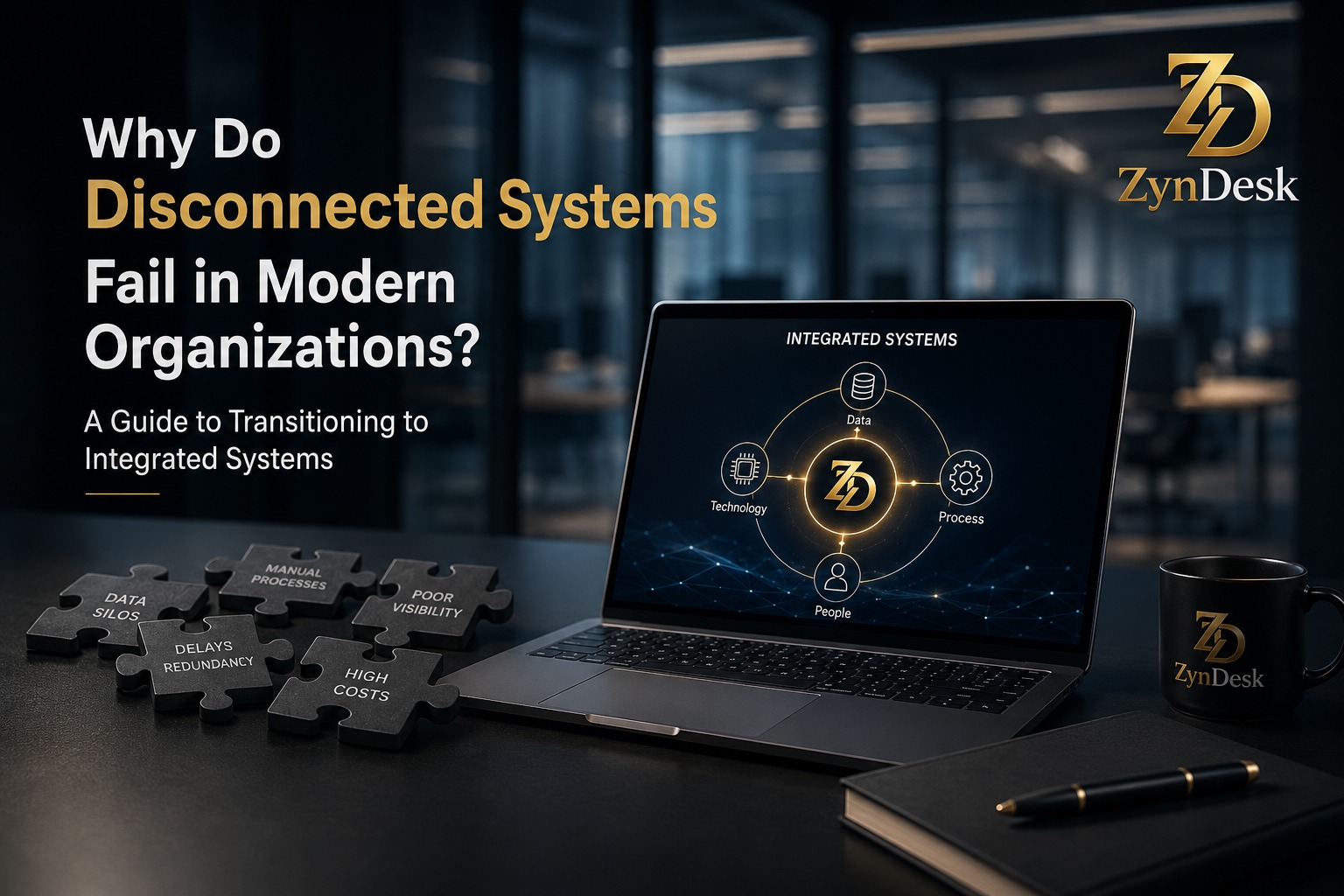
1. Lack of a Unified View of Data
Modern organizations rely on data as one of the most important assets that help them plan and make decisions. However, having separate systems for each department causes this data to become scattered across multiple locations, with each department holding its own copy of information without a unified, reliable source.
For example, the sales system might indicate that a particular customer is one of the top strategic accounts, while this information doesn't appear in the customer service system or the financial system. When management needs to prepare a comprehensive report on this customer, it finds itself forced to manually gather data from several sources — consuming time and increasing the likelihood of inaccurate or contradictory information appearing.
In today's business environment, the speed of accessing data has become just as important as its accuracy. Therefore, the absence of a unified database weakens an organization's ability to respond quickly to changes and make decisions based on reliable information.
2. Repeated Data Entry and Increased Human Error
The more disconnected systems there are, the greater the need to enter the same data more than once. An employee might start by recording customer data in the sales system, then re-enter it in the financial system, and then it gets recorded a third time in the customer service or inventory management program.
While these steps may seem simple, they open the door to many errors, such as:
● Entering different customer data in each system.
● Forgetting to update one of the systems after making a change.
● Duplicate records for the same customer or supplier.
● Discrepancies in prices or quantities between departments.
Over time, these small errors turn into an operational problem affecting the quality of reports, the customer experience, and the efficiency of daily operations.
3. Slow Decision-Making
In the age of digital transformation, managers no longer have the luxury of waiting until the end of the week or month to get reports. Markets change quickly, and customer needs are constantly shifting, making real-time decisions essential to maintaining competitiveness.
But in organizations that rely on disconnected systems, preparing a comprehensive report requires gathering information from several departments, reviewing it, and then manually merging it before presenting it to management. This process can take hours or even days, while the conditions on which the decision was based may have already changed.
Organizations that rely on integrated systems, on the other hand, can generate real-time reports displaying performance indicators, sales, inventory, and financial status on a single dashboard — giving management a clear view that helps them make faster, more accurate decisions.
4. Reduced Efficiency of Collaboration Between Departments
Departments no longer operate in isolation from one another as they once did; the success of any process within an organization depends on continuous collaboration between different teams.
When the sales team successfully closes a new deal, the warehouse department needs to know the order details immediately, the finance department needs to issue the invoice, and the customer service team needs access to the customer's data to provide appropriate support.
In disconnected systems, this information often travels via email, shared files, or even phone calls, leading to slower execution of processes and a higher likelihood of information being lost or delayed.
As the organization grows, this approach becomes increasingly complex, with every simple process turning into a long chain of manual steps that drains employees' time and affects productivity.
McKinsey & Company notes that integrating data and processes within a unified platform helps organizations improve operational efficiency and reduce the time spent executing processes.
5. Difficulty Scaling and Keeping Pace with Growth
Disconnected systems may work well for managing a small company with a limited number of employees, but they begin to lose their effectiveness as activity expands.
When an organization opens new branches, adds different production lines, or enters new markets, the volume of data and daily operations multiplies. At this point, manually linking systems together becomes a heavy burden, and the organization may be forced to hire more employees just to manage and review data.
Instead of technology supporting the organization's growth, it turns into an obstacle that hinders that growth and increases operating costs.
6. Weak Customer Experience
Customers today are no longer concerned only with product or service quality; they now expect an integrated, fast experience at every stage of their interaction with the organization.
When data is spread across multiple systems, customers may encounter frustrating situations, such as:
● Being asked to provide information they've already given more than once.
● Delayed responses because data hasn't reached the relevant department.
● Receiving an invoice containing outdated information.
● Delayed order delivery due to inventory not being updated in time.
All these problems affect customer trust and may push them toward competitors with more integrated, faster systems.
Experience has shown that the problem doesn't lie in the quality of each individual system, but in the lack of integration between them. The wider the gap between systems, the harder data management becomes, the slower operations run, error rates rise, and the organization becomes less able to compete in a market that depends on speed, accuracy, and real-time decision-making.
Gartner reports indicate that organizations relying on integrated platforms enjoy better data visibility and a greater ability to make decisions compared to organizations using scattered systems.
Part Three: The Real Impact of Disconnected Systems on Organizational Performance and Profitability
Having reviewed the reasons disconnected systems can no longer keep up with the demands of modern organizations, the most important question remains: what is the real price companies pay for continuing to rely on these systems?
The answer isn't limited to wasted time or increased administrative burden — it extends to affect profitability, customer experience, competitiveness, and even future growth opportunities. In many cases, management doesn't realize the scale of these losses because they accumulate gradually over time.
First: Reduced Productivity and Wasted Employee Time
One of the biggest challenges posed by disconnected systems is the loss of a significant portion of employees' time on routine tasks that add no real value to the business.
Instead of focusing on business development or improving customer service, employees spend hours on:
● Transferring data between multiple systems.
● Reviewing information to ensure consistency.
● Correcting errors resulting from manual entry.
● Preparing reports from multiple sources.
These tasks may seem simple when viewed individually, but they consume hundreds of hours per month in medium and large organizations, leading to reduced productivity and higher operating costs.
Second: Higher Operating Costs
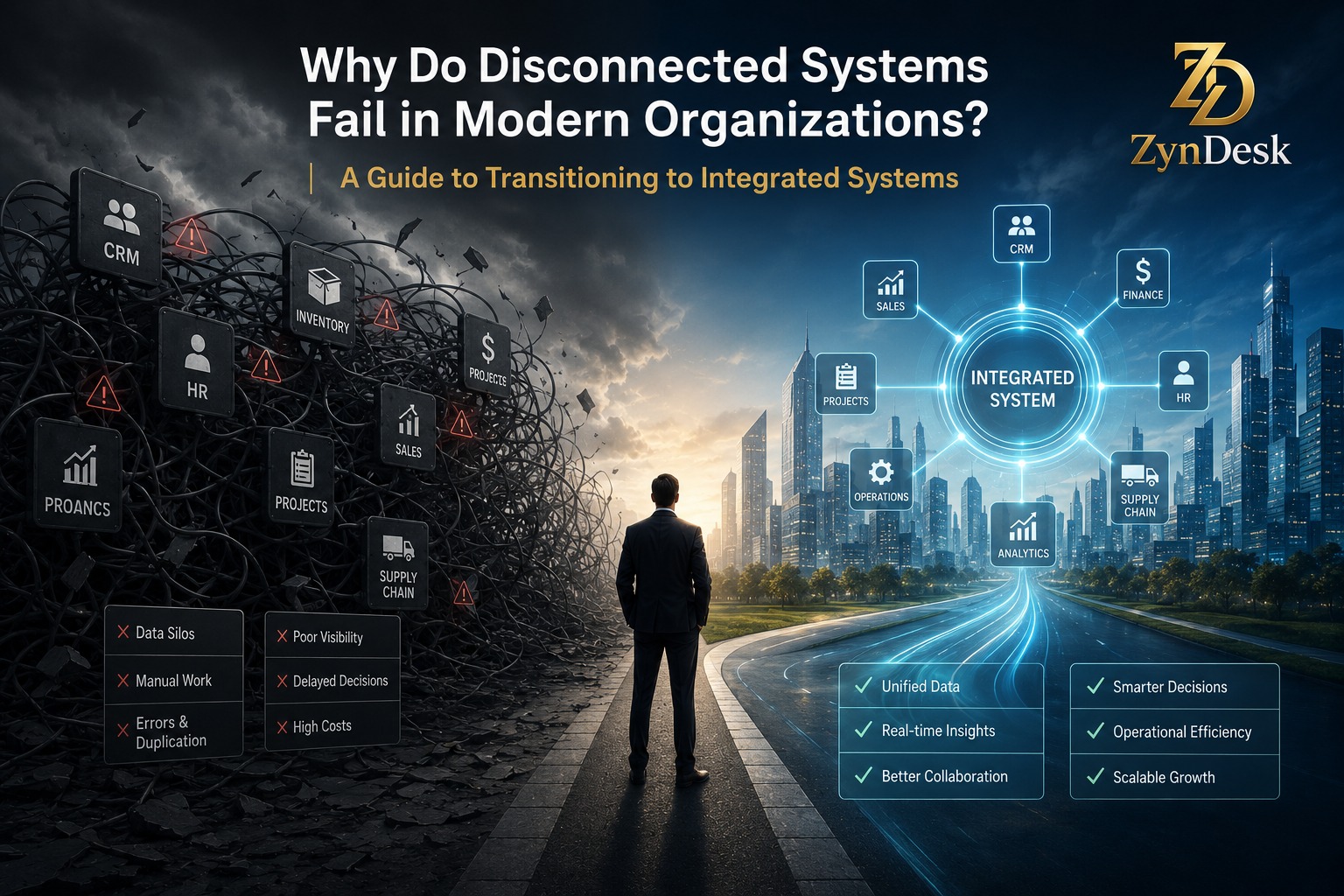
Some organizations may believe that maintaining several independent systems is less costly than investing in an integrated system, but reality is often different.
Disconnected systems mean:
● Multiple subscriptions for different programs.
● Maintenance costs for each system separately.
● The need for various technical support teams.
● Additional expenses to link systems together or transfer data between them.
● Training employees on more than one program.
Disconnected Systems
Integrated Systems
Duplicate data
Unified database
Scattered reports
Centralized reports
Repeated manual entry
Process automation
Slow decision-making
Real-time information
Higher operating cost
Better operational efficiency
Difficulty connecting departments
Full integration between departments
The problem doesn't lie in the number of systems used within an organization, but in the lack of integration between them, which leads to data duplication, workflow disruption, and slower decision-making.
When these costs are added up over the years, many organizations find they've spent significant sums without achieving the operational efficiency they needed.
Third: Declining Quality of Management Reports
Successful management relies on accurate, up-to-date information, but when data is spread across multiple systems, preparing reports becomes a complex process.
Sales figures might appear one way in one report, while revenue data differs in another report, or inventory quantities change without being directly reflected in the financial system.
These inconsistencies leave management facing questions such as:
● Which report reflects reality?
● Are the numbers up to date?
● Can this data be relied upon to make an investment decision?
With this lack of trust in the data, decision-making becomes slower and less accurate.
Fourth: Weak Forecasting and Planning Capability
In modern markets, it's not enough to know what happened in the past — an organization must be able to anticipate what might happen in the future.
But forecasting requires interconnected, comprehensive data, which is difficult to achieve when systems are disconnected.
For example, if a company wants to forecast demand for a product in the upcoming season, it needs to combine data on:
● Past sales.
● Inventory levels.
● Customer behavior.
● Purchases.
● Production plans.
When this information is spread across several systems, producing accurate forecasts becomes extremely difficult.
Fifth: Declining Competitiveness
Competition today no longer depends solely on price or product quality; it also depends on the speed of executing processes, responsiveness to customer needs, and timely decision-making.
Organizations using integrated systems can:
● Generate reports within minutes.
● Track performance in real time.
● Respond quickly to market changes.
● Continuously improve the customer experience.
Meanwhile, organizations still relying on disconnected systems find themselves spending a long time dealing with internal problems, while competitors focus on innovation, expansion, and service improvement.
Sixth: Negative Impact on Employee Experience
The impact of disconnected systems isn't limited to management and customers alone — it extends to employees as well.
Daily work becomes more complicated when employees have to switch between multiple programs, repeatedly enter data, and search for information in different places.
Over time, this leads to:
● Increased job pressure.
● Higher error rates.
● Lower job satisfaction.
● Declining individual productivity.
● Resistance to change within the organization.
When employees feel that technology is hindering their work rather than facilitating it, the organization loses one of the key elements of its success.
Practical Example
Suppose a company has three branches and relies on four different systems to manage sales, accounting, inventory, and human resources.
At the end of each month, the financial manager needs to prepare a comprehensive report on the company's performance. To achieve this, the team starts by gathering data from each system, then reviewing it, then reconciling the figures, then addressing discrepancies, and finally preparing the final report.
This process can take several days, whereas in an organization using an integrated system like ERP, the same report can be generated within minutes using real-time data — saving time and increasing the accuracy of decisions.
Practical experience shows that continued reliance on disconnected systems doesn't just slow down operations — it affects every aspect of the organization, from productivity, through costs and report quality, to customer and employee satisfaction. For this reason, organizations seeking sustainable growth have begun reassessing their technical infrastructure and moving toward integrated solutions that connect departments and data within a single platform.
FAQ
● What do we mean by disconnected systems?
● Why do organizations rely on integrated systems?
● What's the difference between ERP and disconnected systems?
● Can existing systems be merged?
● How does duplicate data affect an organization?
● Is ERP suitable for small businesses?
● How long does the transformation process take?
● What does the transformation cost?
● How do I measure the success of the project?
● Does the transformation affect employees?
● What are the most important criteria for choosing an integrated platform?
● How does ZynDesk help?
Disconnected systems are no longer able to meet the demands of modern organizations that rely on fast information flow, data accuracy, and timely decision-making. As businesses expand and operations grow more complex, relying on disconnected systems leads to data duplication, higher error rates, and weaker collaboration between departments — negatively affecting operational efficiency and the organization's ability to grow.
In contrast, integrated systems enable data unification, process connectivity, and improved information flow across departments, giving management a comprehensive view that helps it make faster, more accurate decisions and achieve greater operational efficiency.
Moving to an integrated platform doesn't mean replacing all systems at once — it can be implemented gradually according to a clear plan tailored to the organization's needs and future goals. Choosing the right solution is a strategic step that helps build a more flexible organization, better prepared to keep up with change and achieve sustainable growth.
Start Your Journey Toward an Integrated Platform
If your organization relies on several disconnected systems, now is the time to assess their impact on efficiency and productivity. Choosing an integrated platform helps unify data, automate processes, and provide a comprehensive view that supports decision-making.
ZynDesk provides a unified work environment that helps organizations manage operations and data efficiently, reducing the complexity caused by multiple systems, with scalability to match business growth.
References
● Gartner – Digital Business Research.
● McKinsey & Company – Digital Transformation Insights.
● Harvard Business Review – Enterprise Management.
● IBM Institute for Business Value.
● Microsoft Work Trend Index.
● PwC Digital Transformation Survey.